Mt Garnet Tin-Tungsten Project

Koba Resources holds a 100% interest in the Mt Garnet Tin-Tungsten Project  located ~100km southwest of Cairns in North Queensland.

The Mt Garnet Project covers approximately 353km2 and is host to extensive mineralisation including more than 300 historical tin mines. This project is heavily underexplored with only 64 holes (for 7,557m) drilled previously. Previous work here has focused on two main prospects: the Boulder Prospect and the Mt Gilmore Mine area.

Gilmore Tin Mine

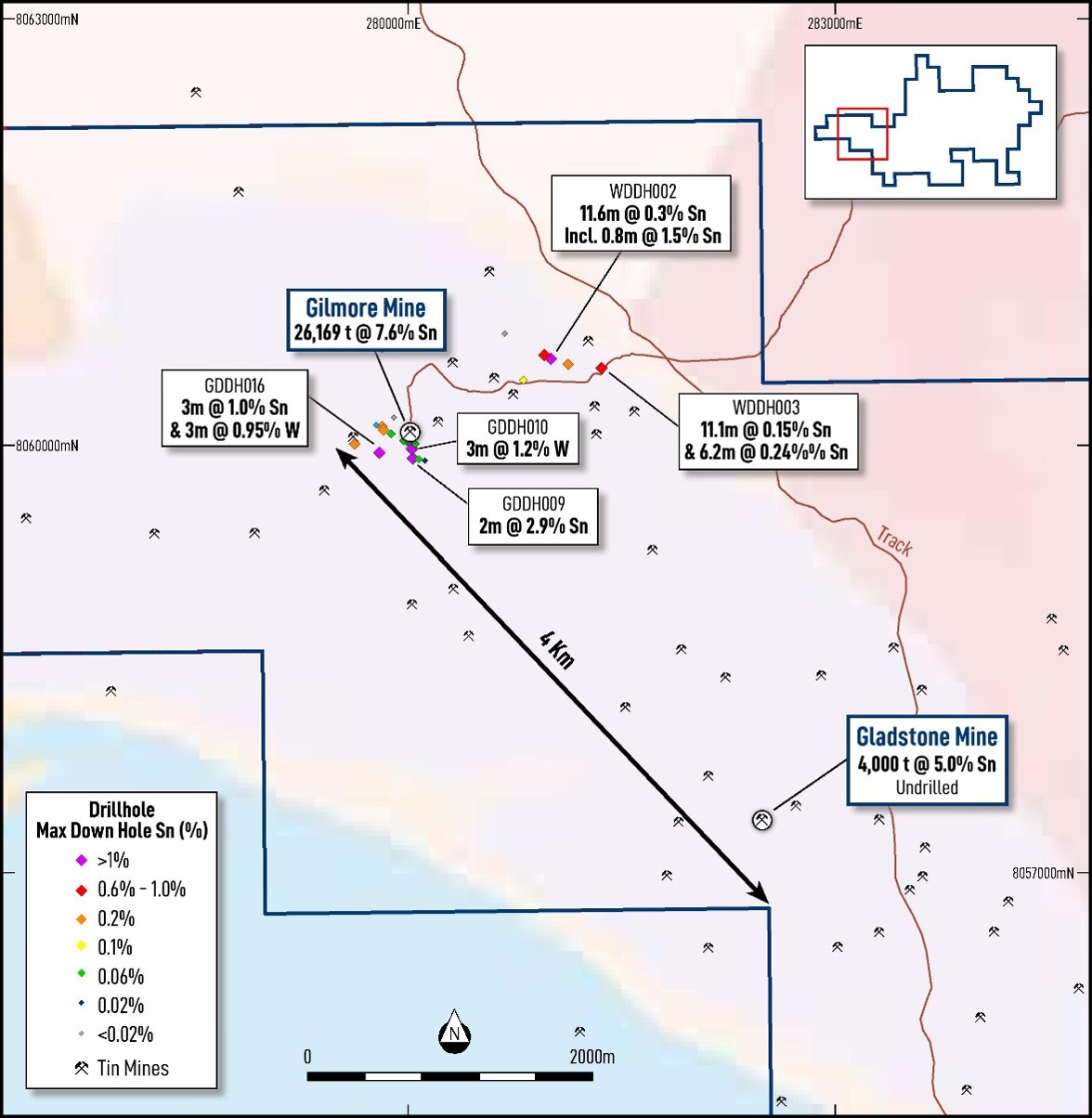
The Gilmore Tin Mine was the largest individual tin producer within Koba’s tenure. Past production reported 26,169 tonnes of ore grading 7.6% Sn. Mining was initially undertaken between 1906 and 1922 before being reactivated between 1958 and 1980, Gilmore reached a depth of 193m via a shaft and adit.

Between 1979 and 1980 a previous explorer drilled 13 holes for 2,070m around the Gilmore Mine to target extensions to the tin mineralisation (see Figure 1). Drilling returned significant results, including:

  • 1m @ 5.2% Sn from 23.8m; and
  • 3m @ 1.0% Sn from 121m.

In addition, notable tungsten mineralisation was intersected, including:

  • 3m @ 1.2% W from 27m; and
  • 3m @ 0.95% W from 175m

Figure 1. Plan showing the location of historic mines and drilling in the Gilmore Mine area, Mt Garnet Tin-Tungsten Project.

Stannex Prospect

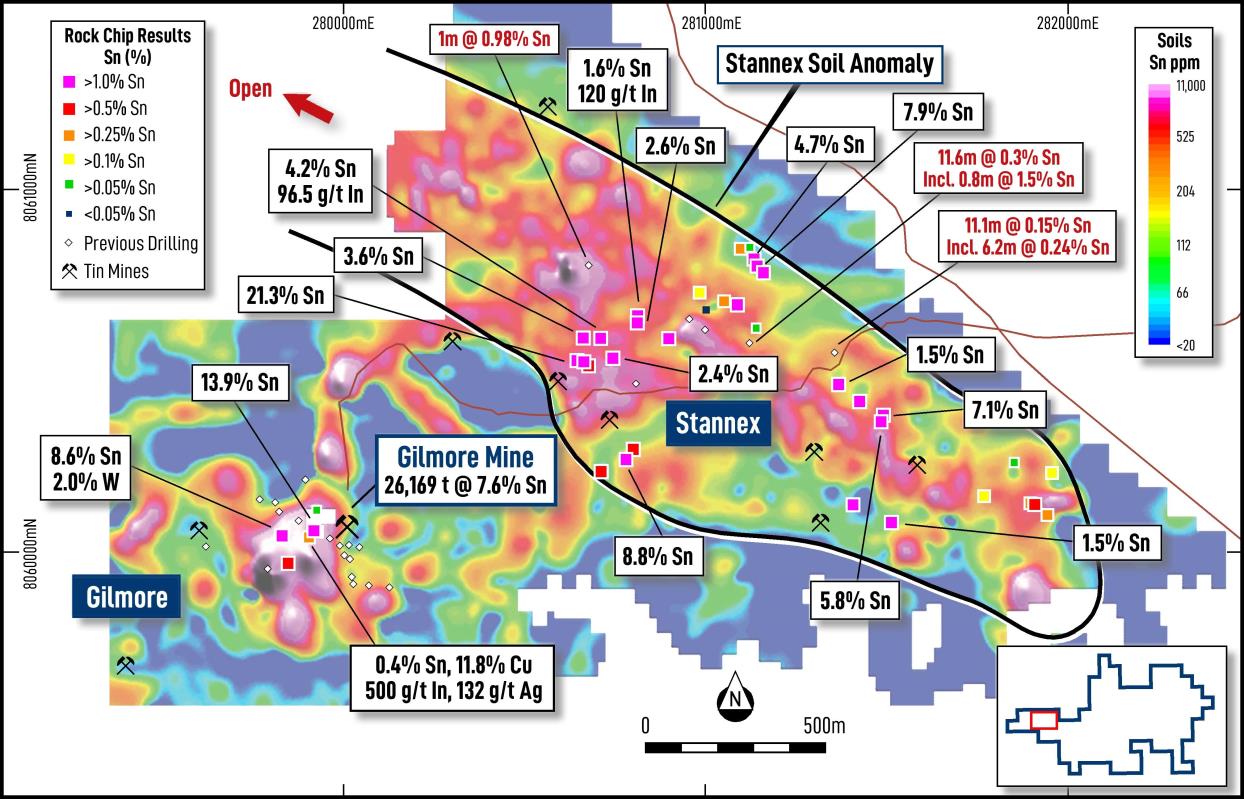
The Stannex Prospect is located approximately 1km east of the Gilmore Tin Mine. During the 1970s a series of very high-tenor tin-in-soil geochemistry anomalies were delineated at the Stannex Prospect and the Gilmore Mine (see Figure 2). The large, strong soil anomaly extends over a strike length of 2km and is up to 0.5km wide at the Stannex Prospect. It remains open along strike to the northwest.

During October 2025 the Company conducted its first work program at the Stannex Prospect, including a rock chip sampling program as part of its initial on-ground reconnaissance. The Company collected 44 samples. Results illustrate that there is widespread, extremely high-grade tin mineralisation associated with the strong tin-in-soil geochemistry anomalies. Better results included:

  • 21.3% Sn (Stannex);
  • 8.8% Sn (Stannex);
  • 7.9% Sn (Stannex); and
  • 7.1% Sn (Stannex).

Only very limited drilling has been completed previously at the highly prospective Stannex Prospect, with a total of six holes drilled (for 756m). Very encouragingly, the historical drilling intersected both high-grade mineralisation as well as thick, lower-grade, potentially bulk-tonnage tin mineralisation, including:

  • 11.6m @ 0.30% Sn from 64.4m; including
    • 0.8m @ 1.5% Sn;
  • 1.0m @ 0.98% Sn from 146.5m;
  • 11.1m @ 0.15% Sn from 11.1m; and
  • 6.2m @ 0.24% Sn from 95.9m.

No follow-up drilling was ever undertaken. This is a high-priority area for follow-up work.

Significantly, reconnaissance work has revealed that the prospective geology at the Stannex Prospect extends for over 4km to the south in a corridor that hosts numerous historical tin mines.

Soil sampling has never been undertaken in this highly prospective area. The Company plans to complete systematic soil sampling throughout this area to define additional drill targets.


Figure 2. Assay results from recent rock chip sampling together with significant historical drilling results on an image of tin-in-soil geochemistry at the Gilmore and Stannex Prospects, within the Mt Garnet Tin-Tungsten Project.

Images 1 & 2: Koba’s sampling crew on site at the Mt Garnet Tin-Tungsten Project and Sample KB037 from the Stannex Prospect that returned assays of 21.3% Sn.

Boulder Prospect

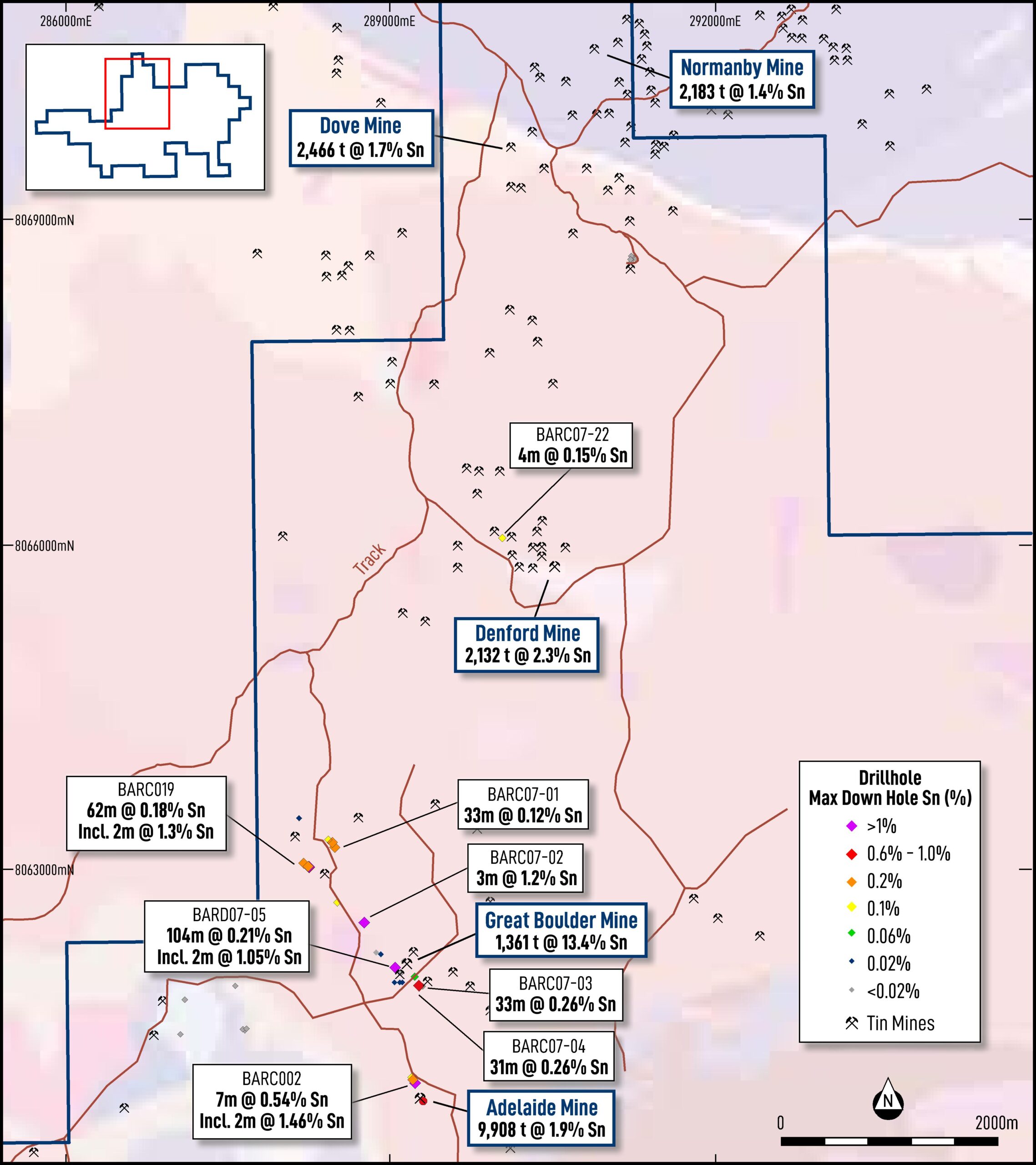
The Boulder Prospect extends over a strike length of approximately 3km, centred on the Great Boulder Mine, which produced 1,364 tonnes @ 13.4% Sn (see Figure 3). The area also includes alluvial tin workings that operated in numerous creeks in the area, predominantly south of the Boulder Prospect.

Mineralisation at the Boulder Prospect is hosted in granite, as cassiterite within quartz veins as well as extensive greisen-altered zones within the granites. Previous explorers identified high-grade mineralisation in drilling, with significant results including:

  • 3m @ 1.2% Sn from 44m;
  • 2m @ 1.5% Sn from 23m; and
  • 2m @ 1.0% Sn from 12m.

In addition to high-grade mineralisation previous explorers identified very thick intervals of lower-grade, bulk-tonnage style tin mineralisation with significant drill results including:

  • 104m @ 0.21% Sn from 12m;
  • 62m @ 0.18% Sn from 23m; and
  • 33m @ 0.26% Sn from 99m.

The Company considers the Boulder Prospect to be highly prospective, with excellent potential to define both very thick, bulk-tonnage style mineralisation and discrete zones of higher-grade tin mineralisation.

Numerous additional historic mines are also present north of the Boulder Prospect in an area that is under-explored, extending from the Denford Mine to the Normanby Mine (see Figure 3). The area warrants further exploration as it has potential for the discovery of similar mineralisation to that identified at the Boulder Prospect.

Figure 3. Plan of the Boulder Prospect showing the distribution of historic mines and drilling including select production figures and significant intercepts part of the Mt Garnet Tin-Tungsten Project.